Monday, April 30, 2012

Emotion


Photo 1
This is one of my favorite pictures because it is more than the eyes that are portraying the emotion. Monica’s hands almost clawing at her face show a bit of frustration as well as sadness. There is use of symmetry in this piece because her nose divides the picture in half and on each side is a hand. This image is a close-up and it works well to capture the emotion because not much other body language is needed for the viewer to understand the overall feeling. 


Photo 2
This picture is an extreme close-up shot. Although her eyes are closed, the emotion can still be understood through the shape of her lips and the lines from her brow. There also is a sense of symmetry in this image because there is symmetry of her face. 


Photo 3
The focal point of this picture is Monica’s eyes. The frustration is clearly seen through the fixation of her eyes. The body language of grabbing at the hair also adds to the emotion. There is a feel to this photo even though nothing was cropped because only parts of her body are seen and the photo is not balanced or symmetrical on both sides.


Photo 4
The focus on Monica’s face as opposed to her hands is key to this photograph. The viewer, although the hand is in the forefront, is drawn to Monica’s face and to the emotion that her eyes portray. There is a deep depth of field because the hand, which is closer, is not seen in sharp focus while Monica’s face, farther away, is more in focus.

Photo 5
This image is taken at a different angle than the other pictures thus far. I am at a higher angle as opposed to straight on. This gives the viewer the feeling that Monica is looking at something in the distance and it also offers a different view of her face. There is happiness in this photograph even though her smile is not as clearly evident and the viewer cannot directly see into her eyes. 
Photo 6
This photograph has more of a classic portrait feel to it then the other images but the emotion is still evident. The tilted head and direct view of the eyes adds to the overall theme of the image. Her shoulder and dress is more out of focus as compared to her face and hand.
Photo 7
This is the only image in this project that shows Monica’s entire body. Her body position adds to the overall feeling of the entire photograph. The door in the background is almost a visual frame because it directs the eye and attention down towards Monica. There is also some symmetry above and below Monica with the empty space. Monica is centered in between the top and the bottom of this image but is not centered when just looking at it from left to right. 
Photo 8
The body language in this photograph really adds to the emotion portrayed. Monica’s face is not centered in this image and the rule of thirds is applied because her face occurs in the upper third of the image. The shape of her arm really stands out in this picture for me and I really like the overall composition of this image.
Photo 9
The body language also shines through in this image as well. The position of her hands and the gesture she is making signals to the viewer what emotion she is trying to portray. Her face is not entirely centered in this image and the empty space in front of her adds some depth to the picture. 
Photo 10
I experimented with the idea of tilting the camera to create a different angle with this image. This kind of skewed presentation adds a little more to this picture as compared to if I just held the camera straight on. Once again, I made sure to not have Monica completely centered in this picture.
Photo 11
This picture has the most emotion portrayed in it by far. The motion-blur that is portrayed adds movement to the photograph even though it makes her a bit out of focus. Monica is more centered in this photograph.
Photo 12
I like how this photograph clearly has a lot of emotion in it even though the only thing that is visible in this image is her face. She once again is not centered in this image because her face is not in the center of the image and there is a cropped feel since part of her hair on the left side is not visible.
Photo 13
This photo emits the feeling of sadness. The lines around her mouth and the position of her eyes indicate this to the viewer. I also like how she is looking down towards the open space that is at the right side of the image. The viewer almost follows her eyesight towards this empty space and leaves you wondering what she is looking at or thinking of.
Photo 14
I like how only one eye is visible in this picture. Just like the last image, her eye draws the viewer towards the white space. The body language of her hand covering her mouth adds extra feeling to the image. I also like the unintentional focus on the ring. Also, the background is so out of focus that you cannot tell that it is a tiled wall. 
Photo 15
The point of view of this shot is different from all the other shots so far. The above the head view gives the viewer a different angle and different perspective. Monica is not at all centered in this image but the empty space doesn’t appear to take away from the emotion portrayed. This emotion is clearly happiness.
Photo 16
This is also an above the head point of view. The body language of Monica biting her tongue and squinting her eyes gives off the emotion of excitement and happiness. Her lower body is out of focus while her head is fully in focus. The light shining in on her face adds some brightness to the picture.




Monday, April 9, 2012

Annie Leibovitz: Life Through a Lens


If you are at all interested in photography, than there is no doubt that you have at least heard the name Annie Leibovitz. She is known for taking very famous pictures of very famous people including George Clooney, Hillary Clinton, John Lennon, Arnold Schwarzenegger and Michael Jackson. She is famous for humanizing the people she takes pictures of and for taking risks with her work. She has shot for magazines such as Vanity Fair, Vogue, and Rolling Stone.

This film about Annie really inspired me as well as taught me about the beauty of photography and about what it takes to get a good shot. Annie’s photographs do more than just capture a moment in time; they tell a story. She describes her photographs as “a portrait of a moment” and there really is no better way of describing it. Each of her pictures has meaning behind it. Sometimes photography can be thought of as just simply pointing a camera at a subject and pressing a button, but that is a terribly mistaken misconception. What is interesting about Annie, and is one of the reasons why she is as famous as she is, is because she gets to know and understand her subjects so that they feel comfortable around her. This intimacy with the subjects allows her to become a part of the scene and to truly capture the emotions and personality of the subject. This kind of intimacy is more than just taking pictures. Her pictures are about capturing a bit of the story of that person. That is why her images are so captivating because there is emotion and power in her images that could not be created without that connection between photographer and subject.

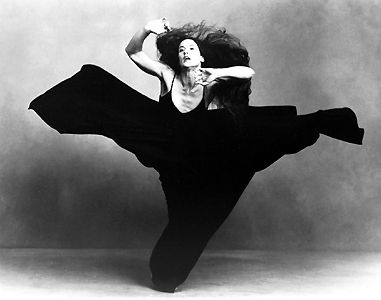
Another thing that is very interesting about Annie is the influence from other photographers that she modeled her own work on. She was very influenced by Barbara Morgan’s photographs of dance and even modeled some of her own dance shots off of her work. She researched the work of other artists and used their work as inspiration for her own shots.


The top image was taken by Barbara Morgan and the bottom image was taken by Annie. Both of these shots have the same point of view however Annie’s shot of the dancer has an aspect of symmetry since the dress comes up on both sides of the dancer and almost frames the dancer in the center of the shot. Both images capture the movement of the dancers through the flows and creases of the dresses and the positions of the dancers.

One of the most humbling moments during the film was when Annie was discussing her faults with one of her photo shoots. It was refreshing to hear from someone who is so famous for her photographs to admit to not always being a professional and for discussing her own failures and setbacks. She said something about the photo shoot that she felt she did not do so well on that really interested me. She said that it is important to, “take your photo to another place—make it meaningful.” This is important because a picture is average unless there is power behind the image. She emphasized taking a picture and bringing it to the next level. When discussing the faults with one of her photo shoots she mentioned that she had subjects but never made them do anything other than just stand in line for the picture. She realized looking back that she could have taken her picture to the next level by using her subjects to create a truly powerful image.

There are so many powerful and moving photographs that Annie Leibovitz has taken and I wish I could include them all here. Instead, I just chose a few of my favorite shots.


This photograph, although humorous, has a strong message behind it. Annie’s vision behind this picture was of Whoopi emerging from the “white” of the milk just as Whoopi in real life had emerged as a black woman in a white world. I really like the point of view of this photograph. By capturing the image from a viewpoint of being above Whoopi we get a full view of her emerging from the milk. If the shot were taken straight on from the side of the bathtub, the message would not be conveyed to the viewer because the full scene would not be pictured.


This photograph is extremely powerful and was also very controversial. This is a portrait of Demi Moore but it is not the average portrait. The portrait is a straightforward shot, which is average for a portrait, but the complete nudity of Demi while pregnant creates a very memorable image.


This shot is really moving because although the Obama family does not appear to be posing or ready for the shot, there is a natural feeling of love and connection. Annie catches the family in an honest moment and I think that is what she does best.


Scavenger Hunt Video

The Chase

Monday, March 19, 2012

Doritos Commercial Review

Doritos commercials are some of my favorite commercials. They not only are good for a great laugh, but they visually present the product really well through different camera angles and shots. This ad especially had a few of the concepts that are discussed in The Bare Bones Camera Course for Film and Video.

This commercial starts off with a close-up shot of a man's hand knocking on a door. The shot is wide enough to understand the environment of the situation. Just from the first shot of the advertisement, the audience is made aware that a man with flowers is knocking on a house door. The shot duration is really quick because we become aware of our surroundings right away and the advertisers do not want to waste any unnecessary time.


The next shot is of a lady opening the door and accepting the flowers with a smile and a "thank you". The camera stays on her face as she accepts the flowers without switching over to the man's face. This ad could be improved if there was some kind of cutaway to the man's face as the lady was happily receiving the flowers because it would have been nice to see his expression.


The next scene is cutting on the action because it is a smooth transition of one shot to the next where the action is the same. In one shot the lady says "thank you" and in the next shot she says "have a seat". It is all one continuous action, but it is presented in two shots. The transition of shots goes from a close-up of the lady opening the door, to a medium shot of the man and the woman standing in her house where the background is her yellow room and only half of their bodies are seen. Also, this is the first time that the man steps into the camera's frame.


In the next scene, there is a quick shot of the woman's lower body as she is walking away. This shot is supposed to be from the man's perspective. The duration of the shot is only a few seconds but it gets the message across. The next shot is a medium shot of a little kid with a game boy controller in his hand.   The boy is not positioned in the middle of the screen, but rather follows the Rule of Thirds and is positioned more to the side. The duration of this shot is very fast.


The next shot is a cutaway of the boy's remote controller which then falls to the ground as the boy drops it. The shot is a close-up because all that is viewed in the shot is the remote controller.


Then the advertising of the Doritos comes into play with a close-up shot of a bowl of Doritos. The audience is reminded what this whole video is about as the focus of the video becomes the bowl of Doritos. The shot is a straight-on view of the bowl. Although randomly positioned in the advertisement, it is well placed because it does a good job of reminding the audience of what the focus of the video is supposed to be about. 


As the older man comes and sits next to the young boy, there are several scene changes that occur. If there was one continual shot, the audience would quickly lose interest in the scene because their eyes would be looking at the same thing. When the scene changes occur, the audience becomes more drawn into the action of the scene. This video does a great job of varying the camera angles and shots and keeping the scene interesting while flowing nicely. 


This video is short but is able to tell a funny story with great transitions. Although the video is only 34 seconds long, it is a good example of how different scenes can be only a few seconds long and how transitions can be used often to better tell a story. Plus, it is a funny and very cute video!

http://www.youtube.com/watch?v=4rsEnwKrsvc

Wednesday, March 7, 2012

Product Placement

Product placement is a type of subliminal or hidden advertising where businesses strategically place their products in TV shows, movies, and video games so they appear as if they are a part of a story's natural environment. Chapter 6 mentions that as more and more people find ways to skip ads on the television, this forces advertisers to get creative with their advertisements. This creativity led to product placement and quite frankly, it is a brilliant idea. Media critic Jeff Smith explains why it is a smart move by stating, "Product placement is one of the ways to reach a captive audience. If you work your product into a TV show or film, it's impossible for the viewer to zap it out." This makes sense because if a captive audience is watching a film where a drink is being subliminally advertised, that audience is going to be much more likely to purchase that drink later on because the drink will be fresh in their minds.

Chapter 6 even mentions the use of digital technology to place products into old television shows. The amount of technology that is available for use today can make any kind of product placement possible. While this is a good thing for advertisers, it does bring about some controversy when answering the question, how much is too much? Product placement is the advertising of the future and is a great way for businesses to advertise their products in ways that really work, but it can get too invasive and become a distraction for the audience. Product placement has become so widespread that even the sitcom 30 Rock makes fun of it in a scene where they talk about Snapple and then show a Snapple advertisement right afterwards. Luckily, as chapter 6 mentions, there are concerned viewers out there who are willing to protest invasive and distracting product placement that they believe goes too far.

Although product placement has its controversies, in the end it is a marketing tool that works. If you really look, they are everywhere. Little did you know that by watching TV, you are being subliminally persuaded to purchase a product.


Product placement is everywhere! If a product name is shown, that means someone paid for it to be there. 

Monday, February 27, 2012

Intermediate Photoshop class


This is just an image that I created in the New Media Center's class for Intermediate Photoshop.